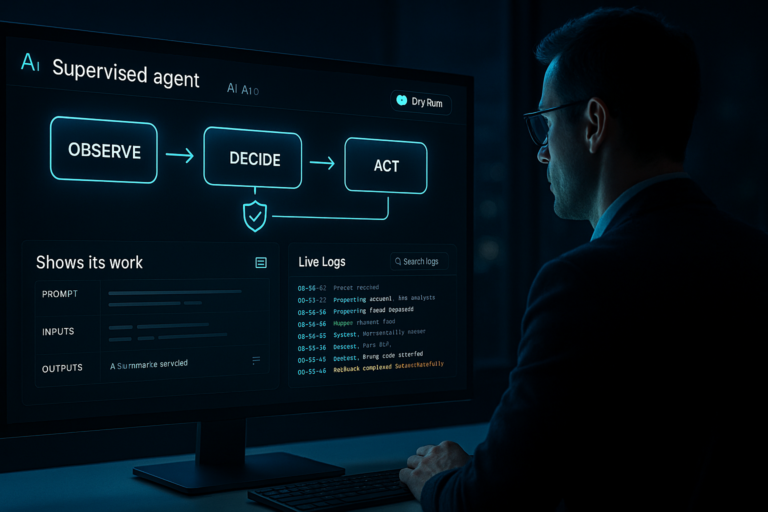


Agentic AI is moving fast, and I can feel the shift in my own workflows. If you’ve been waiting to start, this week made it pretty clear that waiting is the slowest option.
I’m done waiting; this week made it clear that waiting is the slowest option.
Quick answer: Build one tiny agent this week. Give it two tools, a scratchpad, and a confirm step before it writes anything. Write three scenario tests and run them after every change. Why now? On March 28, 2026, Amazon signaled a more agentic Alexa, Solo.io launched a new evaluation benchmark, and real-world ROI hit the news. The door is open for beginners who keep it small and observable.

What changed this week in agentic AI
Alexa is moving from small talk to real actions
On March 28, 2026, TechRadar highlighted Amazon’s shift: fewer chit-chat answers, more multi-step actions across apps and services. Consumer assistants usually trail developer tools, so this is a big mainstream signal. I’m reading it as permission to ship simple, useful automations people can approve with one click.
I’m taking this as permission to ship simple, useful automations people can approve with one click.
AgentBench put evaluation front and center
Also on March 28, 2026, The New Stack covered Solo.io’s AgentBench tackling the core headache: how to know if an agent is actually good. If your agent nails a task once and fumbles the next run, you’re not alone. Benchmarks and scenario tests keep you from guessing. For me, this means starting tiny but measuring consistently.

Real ROI: UiPath says mortgage decisions got 50 percent faster
On March 27, 2026, FinAi News reported UiPath crediting agentic AI for a 50 percent speedup in mortgage decisioning. Boring, regulated workflows are where signal shows up first. If agents can trim hours from document review and validation without breaking compliance, that’s not hype. That same pattern maps to claims, onboarding, KYC, and vendor ops.
Defense work is raising the reliability bar
On March 27, 2026, Military Embedded Systems noted BAE Systems and Scale AI integrating agentic AI into defense platforms. High-stakes adoption usually drags better guardrails, audits, and human-in-the-loop review into the rest of the ecosystem. I’m expecting more practical policy tooling to land in open-source and vendor stacks.
And yes, chaotic agents are getting called out
On March 28, 2026, The Independent asked why no one is stopping runaway agents. I’m not into doom, but I do respect the failure modes: infinite tool loops, over-broad permissions, and silent errors. The fix starts simple. Keep plans short, log every call, and require approval before anything irreversible.
The mental model I wish I had on day one
The five building blocks behind most useful agents
Intent parsing: Turn a vague request into a short plan. Sometimes that’s one step. Often it’s search, summarize, draft, send.
Tools: Where value actually happens. APIs, databases, RPA actions, files, email, calendars. Start with the tools you already trust.
Memory: A tiny scratchpad for steps taken and intermediate results. This alone prevents loops and makes debugging humane.
Policies and permissions: Least privilege by default. Read-only until you’re certain write access is needed, then confirm each action.
Evaluation and oversight: Unit tests for tools, scenario tests for tasks, and human review at the edges. Borrow the spirit of AgentBench even if you don’t use the full harness yet.
A tiny 7-day starter plan
Your one-week sprint
- Pick one workflow you repeat twice a week, like pulling 3 analytics metrics and emailing a summary or turning a Slack thread into a ticket note.
- Give your agent two tools: one read tool to fetch data and one write tool to draft or save.
- Add a scratchpad so the agent lists steps and results as it goes.
- Require a confirmation click before anything gets sent or written.
- Write three scenario tests: normal, weird edge case, and missing data.
Do only this and you’ll feel the compounding effect. If you want to get fancy later, add one more tool or a tiny planner, but not before your tests are green for a week.
I’m keeping it tiny for a week; do only this and you’ll feel the compounding effect.
What I’d use right now
Keep the stack boring and observable
Model with sturdy tool use: Choose a well-supported LLM that handles function calling cleanly. You’re not locked in. Just pass structured inputs to tools and get structured outputs back.
Tool layer: Start with two endpoints or SDK calls you already use manually, like a metrics API and an email or docs API. RPA counts if you live in a Windows or enterprise setup.
Orchestration: A tiny script or notebook is enough. One loop: infer plan, call tool, update scratchpad, check stop conditions.
Logging and review: Append-only logs of every tool call with inputs and outputs. A CSV beats no logs. Keep a one-click approve step for irreversible actions.

Evaluation: Write deterministic scenarios and run them after every prompt tweak, model swap, or tool change. Track pass rates, not vibes.
I run deterministic scenarios after every tweak and I track pass rates, not vibes.
Pitfalls I still see and how I avoid them
Loops, fake tools, and quiet failures
Most early failures look like this: the agent can’t find data, retries the same call seven times, then returns a confident but wrong result. My fix is boring and effective. Shrink the scope, use a scratchpad, and set a retry budget. If a tool errors twice, stop and ask me what to try next.
When things wobble, I shrink the scope, use a scratchpad, and set a retry budget.
Permission sprawl
Agents are not careful by default. I start read-only, then unlock write access per action with a confirmation step. After a week of clean runs, I’ll auto-approve low-risk writes.
No tests, surprise regressions
Agents act like sharp interns. Give them structure. Three scenario tests catch most breakage. I re-run them after every change, even tiny prompt edits. It’s dull and it works.
Why the March 27–28, 2026 dates matter
Alexa’s push goes public: When Amazon hints at agentic behavior, consumer expectations shift toward actions over chat. Plan for multi-step automations.
AgentBench shows up: Evaluation is getting mainstream attention, which means better templates and practices are coming fast. Don’t skip tests.
Enterprise and defense momentum: From UiPath’s 50 percent speedup to defense integrations, reliability, audits, and approvals are the new normal. Build like someone will read your logs later.
FAQ
What is agentic AI in plain English?
Agentic AI is about models that can plan and take actions with tools, not just chat. Think of it like a capable assistant that can fetch data, draft outputs, and follow a short plan you can review.
Can I really build something useful in one week?
Yes, if you keep scope tiny. One repeatable workflow, two tools, a scratchpad, and a confirm step is enough to feel real impact. The win is reliability, not flash.
Are agentic AI systems safe for production?
They can be, with guardrails. Use least-privilege permissions, logs for every tool call, and approvals before irreversible actions. Start read-only and graduate slowly.
Which model or framework should I pick first?
Choose any well-supported LLM with clean function calling and solid SDK ergonomics. Start with a simple script instead of a heavy framework so you can see every step.
How do I evaluate if my agent is working?
Write three scenario tests and run them after every change. Track pass rates, time to completion, and error types. Borrow ideas from emerging benchmarks like AgentBench for structure.
The tiny takeaway
If you’ve been waiting for the right moment to try agentic AI, this was the week. Automate one real task you already do, give it two tools and a scratchpad, add approvals, and write three scenario tests. You’ll end the week with a working agent and a repeatable playbook. I’m doing the same, one small workflow at a time.