

Agentic AI just leveled up. Here’s how I’m moving on it.
Agentic AI quietly clicked into place on March 26, 2026. I spent the morning going through fresh updates across chips, telecom, finance, and insurance, and I pulled out what actually matters plus how I’d start this week without boiling the ocean.
Quick answer: Agentic AI is ready for real work. Hardware is catching up, telcos are shipping closed-loop playbooks, finance is demanding auditability, insurance is going agent-native, and CIOs want guardrails over bigger models. To start: pick one repeatable workflow, add approvals and logging, keep tools tight, and ship a tiny closed loop you can trust.
My move: pick one repeatable workflow, add approvals and logging, keep tools tight, and ship a tiny closed loop I can trust.
First, what is agentic AI in plain English?
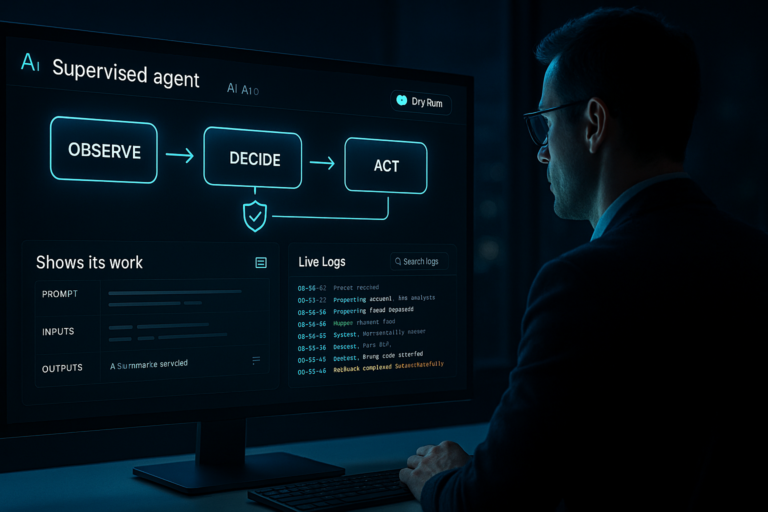
Agentic AI is not just chat. It plans subgoals, calls tools or APIs, checks its own work, and keeps going until it finishes. I treat it like a reliable teammate that can read a doc, pull data, run a script, and summarize the result without me babysitting every step. That’s the jump from answers to workflows.
I treat agentic AI like a teammate that reads docs, pulls data, runs scripts, and summarizes results so I don’t have to babysit every step.
Shift 1: Hardware finally showed up for agents
Arm’s AGI CPU and why I care
On March 26, 2026, Arm announced its AGI CPU built for the agentic AI cloud era. I’m not a chip person, but this matters. Agents are chatty and tool-heavy, bouncing between reasoning and action. Silicon tuned for memory, parallelism, and low-latency tool calls means faster loops and calmer cloud bills. For beginners, it also nudges edge-to-cloud patterns into the doable column.

Shift 2: Networks that fix themselves are here
Telcos finally have a playbook
Also on March 26, 2026, the NGMN Alliance shared guidance for agentic mobile operations. The part I like is the closed loop: agents watch telemetry, diagnose, propose a fix, and auto-remediate or ask for approval. Their paper reads like an ops blueprint, not a slide deck. Even if you’re not in telco, the loop translates to any alert-ticket-playbook world: warehouses, support centers, and cloud infra.

Shift 3: Finance wants agents, with receipts
Governance is the unlock
Same day, trading and payments got a governed copilot. In practice that means if an agent tweaks a risk setting or schedules a payment run, you know what changed, why, and how to roll it back. This is the pattern I’d borrow for any high-stakes flow: auditability is a feature, not a checkbox.
When the stakes are high, I make auditability a feature, not a checkbox.
Shift 4: Insurance underwriting is going agent-native
Automation plus accountability
Underwriting is the perfect agentic workload: messy documents, rules to check, third-party data to fetch, and a rationale to explain. The move I’m seeing is simple: let agents assemble files, highlight gaps, map fields, and draft the justification, while a human owns the final call. You get speed without handing the pen to the model.
Shift 5: Adoption hinges on guardrails, not bigger models
CIOs are pushing safety by default
On March 26, 2026, CIO Dive called it: the blocker isn’t hype, it’s guardrails. If your first demo works, security and compliance questions will show up five minutes later. Plan for them now and you move faster later.
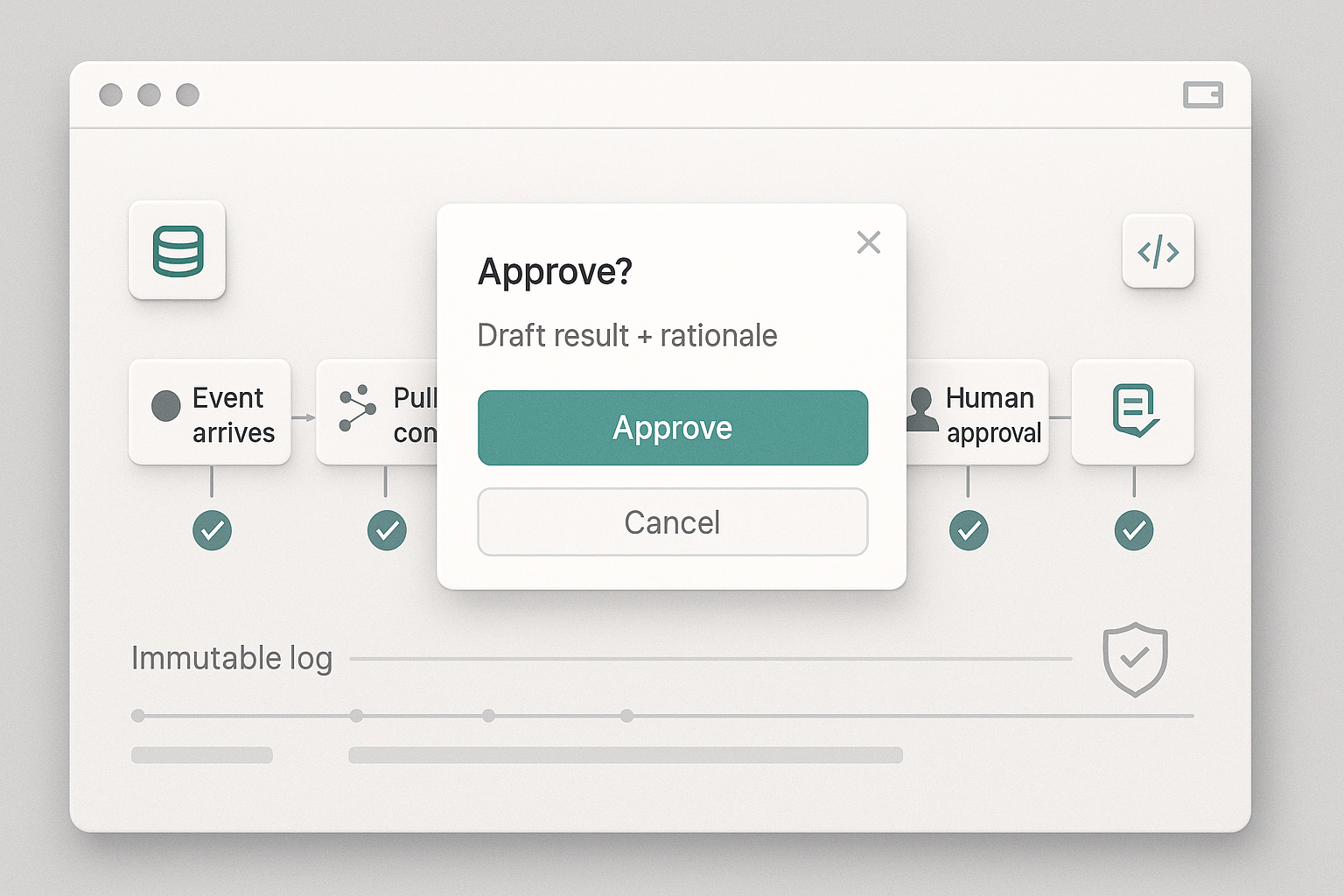
My lightweight guardrail kit I keep reusing:
- Role and permissions that mirror a real persona
- Human-in-the-loop approvals for money, policy, or customer data
- Immutable logs of inputs, tool calls, outputs, and timestamps
- Eval runs on known-answer tasks before production data
- Data minimization in prompts and tool payloads
I plan for security and compliance questions before the first demo so I can move faster later.
If I were starting today, here’s my tiny loop
Pick one job and ship it
I don’t start with a platform, I start with a job: triage vendor invoices, prep a pre-market risk summary, or pre-qualify a small business policy. Keep it repeatable and narrow. Then I wire a loop: event arrives, agent pulls context, runs 1 to 2 tools, drafts result plus rationale, I approve, the agent executes, and it writes a short incident-style note. Everything gets logged.
You can do this with any modern LLM that supports tool calling, a basic vector store, and your app’s APIs. Short prompts, explicit tools. You’re not chasing AGI. You’re shipping a useful teammate.
What today’s announcements told me
Agents are moving from novelty to infrastructure
Hardware is aligning with agent behavior. Operating models are getting published in the open. Finance is insisting on explainability. Insurance is proving document-heavy work fits agents. And IT leaders believe guardrails drive adoption more than raw model horsepower. If that sounds boring, good. Boring ships.
If it sounds boring, that’s good for me, because boring ships.
Beginner mistakes I’m avoiding
I don’t let agents make final decisions where money or compliance is involved. They prep, propose, and explain, and I sign off. I never skip logging. I don’t hand an agent 20 tools on day one. I start with two or three, measure, then add. And I never confuse a chat box with an operating model. The model is the loop plus the guardrails.
Where I’d place my first small bets
Three proofs of concept I’d run now
Ops: a closed-loop incident helper that reads alerts, gathers context, drafts remediation, and files the post-incident note for approval, inspired by the NGMN loop but inside your stack.
Finance or payments: a daily reconciliation agent that flags anomalies against policy and queues corrective entries with a full audit trail. Think governed by design, similar to what smartTrade is aiming for.
Insurance or any doc-heavy workflow: a submission pack builder that ingests PDFs, extracts fields, checks rules, and drafts the rationale. Keep the final decision human and watch throughput jump.
FAQ
What is agentic AI in simple terms?
It’s AI that plans, calls tools, checks its work, and finishes the task without you steering every click. I use it to turn chat into actual workflows that run end to end with guardrails.
How do I start with agentic AI this week?
Pick one small, repeatable workflow. Add approvals and logging. Limit the agent to a couple of well-defined tools. Test on known-answer tasks, then move to real data.
Do I need the latest model to get value?
Usually no. Guardrails, good tool design, and tight prompts beat model sprawl. Faster loops and clear audits will unlock adoption long before you swap models.
Can agents make final decisions in finance or insurance?
I wouldn’t. Let the agent do the heavy lifting and draft the rationale, then keep a human in the chair for the final call. You stay compliant and still move faster.
What logs should I keep?
Inputs, retrieved context, tool calls, outputs, timestamps, and approvals. You want to replay, explain, and roll back with confidence when it matters.
My take
March 26, 2026 felt like puzzle pieces clicking together. Chips, operating models, and governed workflows all lined up. If you’re new to agentic AI, don’t chase platforms. Pick one loop, ship it with guardrails, and let results pull you forward. I’m building a tiny governed agent this week and I’ll share the scars.